

You have the credentials. The job title. The external proof that you are competent.
And yet every time someone praises your work, you think: “They’re wrong. I’m just good at faking it. If they really knew me, they’d see I have no idea what I’m doing.”
Every success feels like luck. Every achievement feels like you somehow tricked people into thinking you’re capable. You are one mistake away from everyone discovering the truth: you don’t belong here.
This is imposter syndrome.
Here is what most people don’t understand: imposter syndrome is not about lacking confidence. It is not about needing more evidence of your competence. You can have an entire wall of achievements and still feel like a fraud.
Because imposter syndrome is not about what you have achieved. It is about who you believe you are.
For many people, this pattern operates at a level deeper than conscious thought. The external proof says “you are capable.” The internal belief says “you are not who you appear to be.”
And no amount of success can override a belief that formed before success was even possible.
This is what is actually happening beneath imposter syndrome: a disconnect between your self-perception and the evidence.
Signs of Imposter Syndrome (And Why You Probably Don't Recognise Them)
Imposter syndrome does not look like insecurity on the surface. It often looks like high performance driven by fear.
These are the signs many people don’t recognise as imposter syndrome because they look like ambition, conscientiousness, or professionalism.
TABLE 1: How Imposter Syndrome Actually Shows Up
What You See on the Surface | What’s Actually Happening Inside |
Overworking, over-preparing for every task | Trying to compensate for the belief you’re not inherently capable |
Perfectionism, feeling like nothing is ever good enough | If it’s not flawless, people will see you’re a fraud |
Downplaying achievements, deflecting praise | Can’t accept recognition because it contradicts “I don’t deserve this” |
Attributing success to luck, timing, or other people | Refusing to claim your own competence |
Avoiding new opportunities despite qualifications | Fear of being exposed in unfamiliar territory |
Feeling anxious when visible or in leadership | Visibility means more chances to be discovered as a fraud |
Constant comparison to others | Using external standards to confirm you’re not enough |
Why high achievers experience this most
Imposter syndrome is not more common in people who lack competence. It is more common in people who have achieved beyond what their sense of self can integrate.
You were told, or shown, early on that you were not enough. So you worked harder. You achieved more. You built proof.
But the belief “I am not enough” formed before you had achievements. And when the external evidence contradicts the internal pattern, the pattern does not update automatically. Instead, it reinterprets the evidence.
Success becomes: “I fooled them.” Recognition becomes: “They don’t really know me.” Achievement becomes: “I got lucky this time.”
Self Assessment
☐ Do you feel like you’re performing a role rather than being yourself?
☐ Does success trigger anxiety instead of satisfaction?
☐ Do you dismiss your achievements as luck or timing?
☐ Do you feel like you’re one mistake away from being exposed?
☐ Do you work significantly harder than necessary to prove you belong?
☐ Does visibility or recognition make you uncomfortable?
☐ Do you believe other people in your position are more naturally capable?
If you answered yes to 4 or more, you may be dealing with a deeper imposter pattern rather than ordinary situational self-doubt.
BEFORE YOU READ FURTHER
Imposter syndrome is one pattern that can create these experiences, but it is not the only explanation. If you are experiencing severe anxiety, depression, panic attacks, or symptoms that significantly interfere with your ability to function, please consult a GP or psychologist for clinical assessment. The insights here can support deeper pattern work, but they are not a substitute for mental health care when that is what the situation requires. |
What Causes Imposter Syndrome (And Why Success Doesn't Fix It)
Imposter syndrome often has roots in early experiences where your sense of worth became conditional, unstable, or tied to performance rather than inherent value.
Research on self-perception and achievement shows that imposter feelings are particularly common in high-achieving individuals, especially when early environments emphasised conditional approval or created insecurity around belonging (Clance and Imes, 1978).
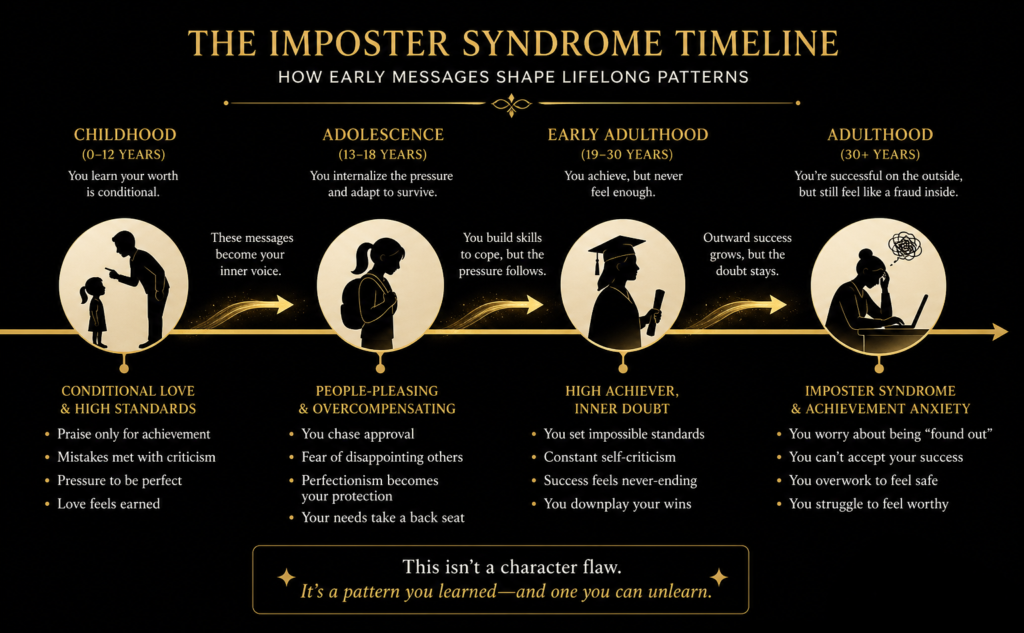
TABLE 2: How Imposter Syndrome Often Gets Formed
Early Experience | What the Child May Learn | How It Shows Up in Adulthood |
Love felt conditional on achievement | “I only have value when I perform” | Success never feels like enough, constantly proving worth |
High standards, criticism for mistakes | “Anything less than perfect means I’m a failure” | Perfectionism, paralysis, fear of being exposed |
Praise for being naturally talented | “If I have to work hard, I’m not really smart” | Hiding effort, feeling fraudulent when things are difficult |
Being different or standing out | “I don’t naturally belong here” | Chronic outsider feeling, even in spaces you’ve earned |
Family or cultural pressure to succeed | “My worth is tied to what I achieve for others” | Achievement feels like obligation, not personal success |
Inconsistent validation | “I can’t trust positive feedback” | Dismissing praise, waiting for criticism |
Research on self-compassion suggests that when self-worth is built on external validation rather than inherent value, achievement can become a source of anxiety rather than confidence (Neff, 2011). You achieve to avoid the pain of feeling “not enough,” not because you believe you deserve success.
This is why success does not fix imposter syndrome. Each achievement raises the stakes. Each promotion increases visibility. Each recognition creates more pressure to maintain the illusion.
The pattern is:
Achieve. Feel like fraud. Work harder to compensate. Achieve more. Feel like bigger fraud. Repeat.
And the underlying belief remains untouched: “I am not who I appear to be.”
DOES THIS APPLY TO YOU? This pattern is most likely if: the feeling of being a fraud persists across multiple contexts and achievements, not just in one new situation; your response to success is anxiety or fear of exposure rather than satisfaction; and the belief feels automatic and deeply embedded rather than situational. This may not be the primary pattern if: you feel like a fraud only in genuinely new situations where you lack experience; your self-doubt reduces with practice and evidence; or you can accept praise and recognition without immediate dismissal. See a professional if: the anxiety is interfering with your ability to work or function; you are experiencing panic attacks, severe depression, or thoughts of self-harm; or the pattern is accompanied by trauma symptoms that need clinical support. |
Imposter Syndrome at Work (Why It Gets Worse with Success)
For many people, imposter syndrome is most acute in professional settings. The higher you climb, the more intense it becomes.
Work creates visibility. Your competence is constantly evaluated. Mistakes have consequences. And for someone who already believes they don’t belong, every day feels like walking a tightrope.
When you are genuinely competent, people give you more responsibility. The paradox is this: the better you are at your job, the higher the expectations. And if you believe you are faking it, higher expectations feel like higher stakes.
Common workplace triggers
- Promotions: Instead of validation, they create terror. “Now I’m really going to be exposed.”
- New roles: Unfamiliar territory confirms the belief “I’m not naturally capable, I just got lucky before.”
- Praise from leadership: Feels like pressure. “They think I’m better than I am. I have to keep up the act.”
- Team mistakes: Even when not your fault, they feel like evidence. “If I were really competent, this wouldn’t have happened.”
- Comparison to colleagues: Everyone else seems confident and natural. You feel like the only one faking it.
Here is what makes workplace imposter syndrome particularly exhausting: you cannot just achieve your way out of it. The better you perform, the more you have to lose. The more successful you become, the higher the stakes of being “found out.”
This is why many high achievers secretly hope to stay under the radar despite their ambition. Visibility feels dangerous.
This same fear of visibility drives another pattern high achievers often miss: the difficulty of setting and holding boundaries. When approval feels tied to safety, saying no can feel far more threatening than it should.
Why Positive Thinking Cannot Touch This
If you have tried affirmations like “I am capable” or “I deserve success” and felt like you were lying to yourself, you were not doing it wrong.
For many people, imposter syndrome operates at a level that conscious repetition cannot easily reach.
The belief “I am not who I appear to be” is often not a thought you think. It is a pattern that runs automatically, formed through years of conditional worth, comparison, or the message that you had to earn your value.
Repeated emotional experiences can shape automatic patterns of fear, self-doubt, and self-protection that are not easily changed through conscious reasoning alone (van der Kolk, 2014). When your nervous system learned “visibility is dangerous” or “mistakes mean rejection,” that response may not update simply because your conscious mind now knows you are competent.
This is why you can logically know you are qualified and still feel like a fraud. The logic lives in your conscious mind. The pattern may be operating in your nervous system and deeper self-perception.
Positive thinking tries to override the pattern using conscious repetition. But if the pattern was shaped emotionally and relationally through lived experience, conscious thought alone often struggles to change it.
The work that creates lasting change addresses the pattern where it actually operates.
WHAT TO DO ABOUT IT If positive thinking has not worked, that is not a personal failure. It is a mismatch between the tool and the problem. Approaches that often help address deeper patterns include: working with a therapist who understands imposter syndrome and can address the underlying self-worth wound; somatic or body-based work that helps your nervous system learn that visibility and success are not threats; relational therapy that provides consistent, unconditional regard as a corrective experience; and self-compassion practices that focus on inherent worth rather than conditional achievement. Different layers of the problem often require different layers of support. |
How to Overcome Imposter Syndrome
Overcoming imposter syndrome is not about forcing yourself to feel confident. It is about changing the pattern that keeps interpreting success as danger, fraud, or luck. That usually happens across several layers.
Layer 1: Name it as a pattern, not truth
The feeling “I’m a fraud” is not proof that you are one. It is evidence that a familiar pattern has been activated. Naming that distinction creates the space to respond differently instead of collapsing into it.
Layer 2: Work with the nervous system
Imposter syndrome often triggers a nervous system response: anxiety when visible, panic before presentations, hypervigilance about mistakes. Approaches that calm the nervous system, such as breathwork, EMDR, and somatic therapy, can help your body learn that visibility and success are not threats.
Layer 3: Reframe effort as competence, not fraud
Many people with imposter syndrome believe that if something feels hard, it means they are not really capable. That belief makes effort feel like evidence of fraud. Effort is not proof of inadequacy. It is part of how real competence is built.
Layer 4: Seek relational repair
If the original wound was relational, healing is often relational too. Therapy, coaching, or mentorship can help create a different experience of being seen: one where your worth is not constantly being measured against performance.
Layer 5: Work at the self-worth level
For many people, imposter syndrome sits on top of a much older self-worth pattern. If that belief stays intact, success will keep feeling unstable no matter how much evidence you gather. It helps to understand the self worth foundation beneath everything.
Professional support that specifically addresses imposter syndrome often includes cognitive approaches to challenge distorted thoughts, self-compassion work to address conditional self-worth, somatic therapy to calm nervous system responses, and relational therapy to provide corrective experiences.
Layer 6: Allow integration time
Your achievements are real. Your competence is real. But if your internal model has been organised around “I’m not enough,” it takes time for the nervous system and sense of self to catch up. Integration is part of the work, not evidence that it is failing.
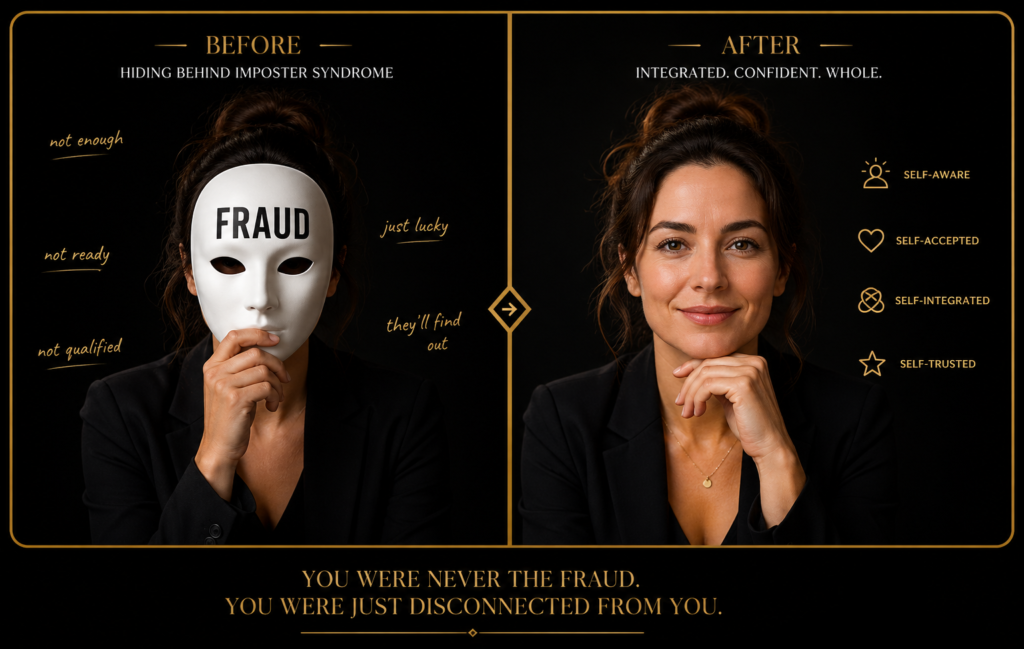
TABLE 3: What Actually Changes
Before | After |
Success feels like fraud | Success feels earned and deserved |
Praise triggers anxiety | Praise can be received without dismissing |
Visibility feels dangerous | Visibility feels neutral or energising |
Mistakes confirm “I’m not enough” | Mistakes are learning, not threats to worth |
Constantly proving worth | Worth exists independent of performance |
Hiding effort, faking ease | Effort is valued, not hidden |
Frequently Asked Questions
Add Your Heading Text Here
No. Imposter syndrome is the specific belief that your competence is an illusion and you will be exposed as a fraud. Low self-esteem is broader negative self-evaluation. You can have high self-esteem in some areas and still experience imposter syndrome in achievement contexts.
Why do successful people have imposter syndrome?
Imposter syndrome is not caused by lack of success. It is caused by a disconnect between external achievement and internal self-perception. When you achieve beyond what you believe you deserve, the pattern reinterprets success as fraud rather than updating your sense of self.
Can imposter syndrome go away?
Yes, but it requires addressing the underlying pattern, not just building confidence. For many people, the pattern significantly reduces when they work on the self-worth foundation and learn that their value is not conditional on performance.
Is imposter syndrome more common in women?
Early research suggested it was, but more recent studies show it affects people of all genders at similar rates. What differs is often context: women may experience it more in male-dominated fields, while men may experience it when emotional vulnerability is required.
How do I know if I have imposter syndrome?
If you consistently feel like a fraud despite evidence of competence, attribute success to luck rather than ability, fear being exposed as incompetent, or experience anxiety when receiving recognition, you may be experiencing it.
Can therapy help with imposter syndrome?
Yes. Therapy that specifically addresses imposter syndrome works with the underlying pattern. Effective approaches often include cognitive work to challenge distorted thoughts, self-compassion practices, somatic therapy to calm nervous system responses, and relational therapy for corrective experiences.
What if I achieve something and still feel like a fraud?
This is the core pattern. Achievement does not fix it because the issue is not lack of evidence. The pattern reinterprets evidence to fit the existing belief. The work is addressing the pattern itself, not accumulating more proof.
You Are Not a Fraud
If you are reading this and recognising yourself, here is what you need to know:
The fact that you feel like a fraud does not mean you are one.
It means you learned early that your worth was conditional. That you had to perform to be valuable. That mistakes meant rejection.
And now, even when you succeed, the old pattern runs: “This doesn’t count. You’re still not enough.”
But that pattern is not truth. It is learned. And what was learned can be updated.
You are not an imposter. You are someone whose self-perception has not yet caught up with the evidence of your capability. And that gap can change.
If this pattern feels familiar, start with the Self Esteem guide to understand why achievement can still feel hollow when the foundation beneath it is unstable.
And if confidence is the word you have been using for this struggle, the next piece to read is on what real inner confidence actually looks like and why it is not the same as performance.
The work begins with seeing the pattern for what it is: not who you are, but what you learned about who you are.
And that is where real change becomes possible.
Which part of imposter syndrome feels most familiar to you: dismissing praise, overworking to compensate, fear of being exposed, or struggling with visibility? |
SCIENTIFIC REFERENCES
Clance, P. R., and Imes, S. A. (1978). The imposter phenomenon in high achieving women: Dynamics and therapeutic intervention. Psychotherapy: Theory, Research and Practice, 15(3), 241 to 247.
Neff, K. D. (2011). Self-compassion, self-esteem, and well-being. Social and Personality Psychology Compass, 5(1), 1 to 12.
van der Kolk, B. (2014). The Body Keeps the Score: Brain, Mind, and Body in the Healing of Trauma. Penguin Books.
LEGAL DISCLAIMER
The information provided in this blog post is for educational purposes only and is not intended as a substitute for professional medical or psychological advice, diagnosis, or treatment. Always seek the advice of your physician, psychologist, or other qualified health provider with any questions you may have regarding a medical or psychological condition. Never disregard professional medical advice or delay in seeking it because of something you have read in this blog post. If you are experiencing a mental health crisis or thoughts of self-harm, please contact emergency services or a crisis helpline immediately.

Identity Foreclosure: When You Built a Life Around Who You Had to Be

Conflict Avoidance: Why Keeping the Peace Costs You Everything


2 thoughts on “Imposter Syndrome: Why High Achievers Feel Like Frauds (And What Actually Works)”
this is the testing
Yes this the testing purpose